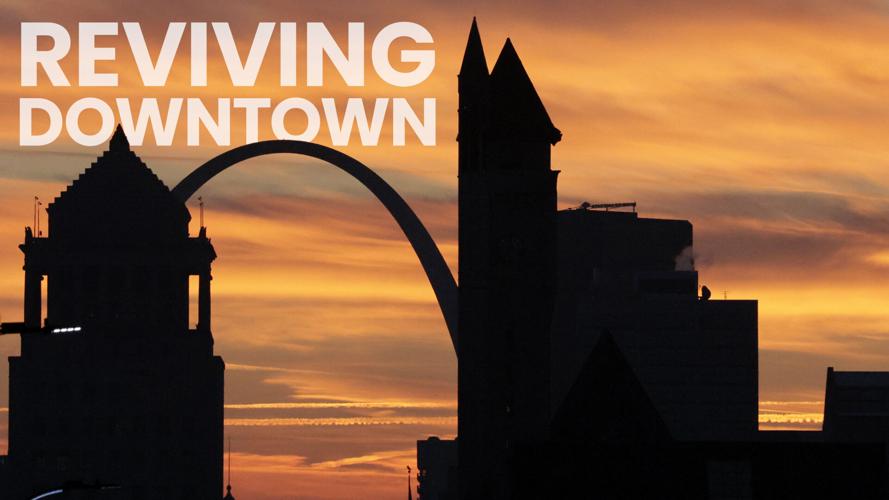

It was the first day of April at Busch Stadium, and the Cardinals were on their way to clinching a series against the New York Mets. As Mets announcers Gary Cohen and Todd Zeile (a former Cardinal) called the second inning, the video cut away to a live shot of an empty Kiener Plaza, with the Gateway Arch looming in the distance.
“The only thing missing from that picture,” said Cohen, “as is often missing from every picture we show of downtown St. Louis — ”
“No people,” chimed in Zeile.
“No people,” repeated Cohen. “There’s never anybody walking around in downtown St. Louis … It’s like, remember the old neutron bomb that wouldn’t knock down buildings but just would eliminate all the people? It’s like one of those hit St. Louis.”
People are also reading…
Ouch.
Yes, it was a cheap shot. Yes, some out-of-towners can be brutal in their assessment of our city’s front stoop.
But they're not the only ones.
When it comes to the public image of downtown St. Louis — a crucial challenge to drawing tourists, conventioneers and other visitors — the neighborhood’s biggest problem might be … St. Louisans.
“If there was one story that was told to us more than any other, it was how local St. Louisans are the biggest detractors of St. Louis,” says a report commissioned last year by Explore St. Louis, the city's marketing arm, on how to boost downtown convention and tourism activity.
The report’s advice: “Transform the mindset of St. Louisans to become enthusiastic promoters.”
The Post-Dispatch Editorial Board this week is publishing a series of editorials exploring how St. Louis can revive its downtown/Downtown West corridor. That’s the more than two-square-mile stretch from the Arch grounds on the east, Jefferson Avenue on the west, Chouteau Avenue on the south, and just beyond Washington Avenue on the north. We are keeping all the editorials in the series outside our paywall, free to everyone, to include as many community members in the conversation as possible.
Today, we focus on the neighborhood’s national reputation for being lifeless and empty — and the even more damaging message that neighbors across the St. Louis metropolitan area often send.
Countering that reputational punch is crucial to building a healthy tourism and convention business. And it must start with our fellow St. Louisans.
There's a pervasive and damaging attitude among residents who have come to see downtown through a prism of misperceptions — especially the idea that the neighborhood is a crime-ridden shooting gallery.
That’s not to say that rare but shocking anecdotes about downtown chaos don’t have an impact on our national image, with resulting blows to our tourism and convention activity.
But even the biggest downtown boosters can’t deny what those Mets announcers observed during that April ballgame: the lack of downtown life — of activity. It should instead be teeming, especially around major events. The Explore St. Louis report called it "low brand visibility."
“Overwhelmingly, local St. Louisans believe that the biggest challenge the visitor economy faces is the perception that St. Louis is an unsafe destination,” it states. “Interestingly, while safety is a significant issue, other data points to the biggest problem being that St. Louis is not even on potential visitors’ radar as a place to visit.”

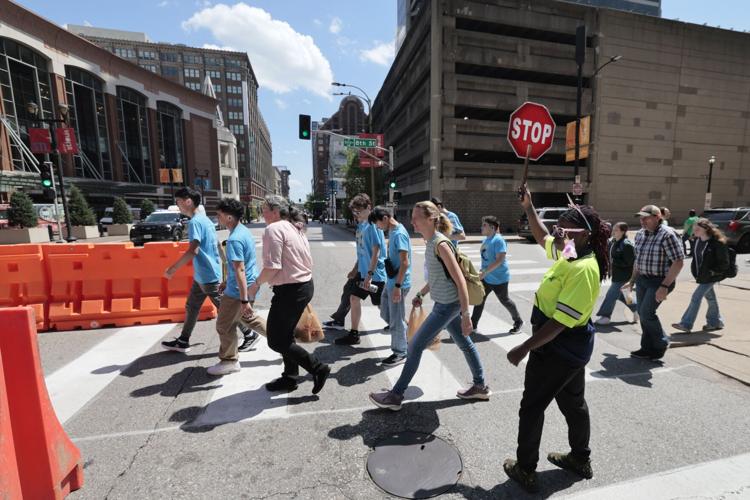
Cross guard Merlene Perkins ushers pedestrians across Washington Avenue on Thursday, April 23, 2026, during lunch hour outside the Dome at America’s Center, which was hosting the 2026 VEX Robotics World Championship in downtown St. Louis.
A damaging cycle
How a perceived lack of safety can directly impact convention business was tragically demonstrated in 2023.
On the night of Feb. 18 of that year, Janae Edmondson, 17, a Tennessee high schooler participating in a volleyball tournament at the Dome at America's Center, was struck by a speeding car as she walked with her parents near St. Charles and 11th Street, just off Washington Avenue. She ultimately lost parts of both her legs. It was a national story.
Four months later, Dot Foods, which had for about 20 years held its major annual trade show at the Convention Center, announced it was ending its relationship with St. Louis and moving its convention to Denver. The company cited safety concerns from employees and customers.
“It is important for us to keep increasing the number of customers and suppliers that attend our show,” Dot CEO Dick Tracy said at the time. “There is already a long list of barriers in making that happen, and we don’t need safety to be yet another one.”
It was a gut-punch. But was it fair?
This editorial series tackled the perception of a crime-ridden core earlier this week, showing that actual numbers tell a different story. Which brings us back to the damaging cycle: an isolated but high-profile incident feeds misperceptions among area residents that downtown is constantly dangerous; they bemoan the state of public safety; the national reputation takes a new hit.
Boosting our national reputation and luring visitors to downtown helps all of us — from St. Charles to south city. At stake is money and jobs. We're not saying to gloss over glaring issues and put a happy spin on them. But we also can't keep being our own loudest detractors, especially when facts and first-hand experiences can paint a different picture.
Besides, we'd argue, as did the Explore St. Louis report, that there are other forces at play. And that takes us to football.
Losing a team, losing attention
There are few events more major to an American city than regularly hosting National Football League home games. St. Louis' loss of the Rams 10 years ago was not a mere punch to the gut — it was flying kick to the gut. We're still trying to recover a decade later.
The economic impact is obvious. But how much has it also undermined our downtown's stature? Anecdotally, St. Louisans can get an idea of the damage on any given Sunday, when they turn on their TVs and see Kansas City. The Chiefs and their three recent Super Bowl wins have given KC plenty of buzz. It's hard to match that level of attention.
The St. Louis Business Journal sought to quantify the issue two years ago. The outlet commissioned an analysis of mentions of Kansas City in U.S. publications with circulations of more than 500,000. It found KC was mentioned more than 282,900 times in 2023.
Mentions of St. Louis, with its bigger metropolitan area? Fewer than 169,340.
What good news the study had for St. Louis was that its national profile has tended to rise in years when the Cardinals or Blues have done well, or when the city hosts nationally watched events like a presidential debate. And, yes, landing City SC and the construction of Energizer Park have been big wins.

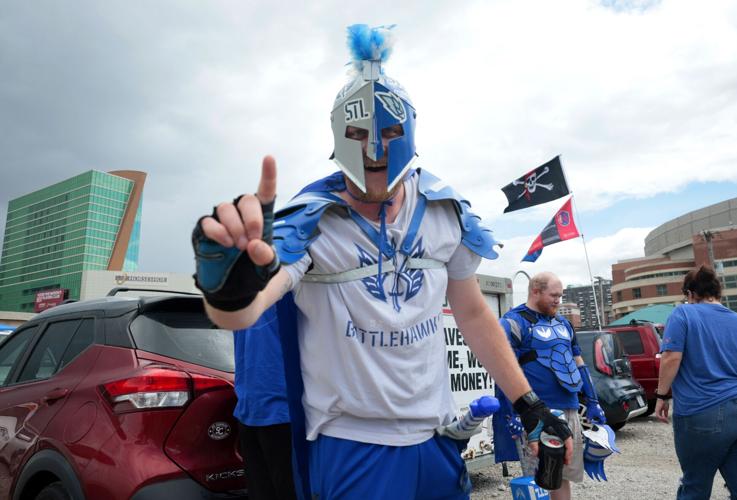
St. Louis Battlehawks fan Troy Guffey cheers before a game on Saturday, June 1, 2024, at the Dome at America’s Center in St. Louis.
But on too many days, without a big event to bank on, downtown is vulnerable to, well, cheap shots from New York Mets announcers.
That’s certainly the case around America's Center, especially at night.
“We wish things stayed open a little later,” Bishop Tommy Williams, in town from Memphis with a convention of the Joint College of African-American Pentecostal Bishops, said on a recent mid-March afternoon.
He was standing on a sidewalk across Washington Avenue from the National Blues Museum.
The bishops’ nightly services at the convention generally started around 7 p.m. and lasted three or four hours. The most visible sit-down restaurant nearby, Sugarfire Smoke House, closes at 8 or 9 p.m. most nights.
“About the time we get out of our services, things are closed,” Bishop Williams said.
Bishop Kenneth Taylor, also from Memphis, nodded in agreement. “You guys don’t stay open late here.”
Almost as if on cue just two weeks later, the National Blues Museum, a tourism staple for the past decade, suddenly announced its permanent closure. A key reason it cited? "The economic climate of downtown St. Louis."
The lesson isn't that St. Louis should be vying again for a music-themed museum or an NFL team — the football play is over, at least for the foreseeable future — but that attention is a commodity our city doesn't have enough of these days.
That translates directly into loss of potential visitors and the dollars they bring. So what can we do about it?
Leverage what you have
It's not like we don't have any tools at our disposal. We can start by more fully leveraging the big commodities we still have.
We have a great story to tell with City Museum, CityGarden and other spots. And, of course, there's the Arch.

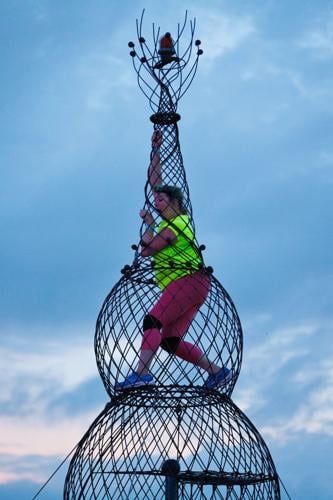
Steph Noakes, of St. Louis, climbs to the top of a structure at an ’80s prom-themed party Aug. 4, 2023, on the rooftop of City Museum.
“I can't overstate how truly magnificent the renovation of the Arch grounds is,” Mayor Cara Spencer recently told the Editorial Board. “But let's face it: there's nothing to do down there.”
“You can't get a bite to eat, you can't stick around and have a cocktail and enjoy it on a patio. There's no pavilion, there's no European-style gathering spot. We need to have places that allow you to stick around and stay for a while and really enjoy.”
As others we’ve talked to have done, Spencer pointed to Detroit as a potential inspiration for how to change downtown St. Louis’ trajectory in the eyes of the world. Detroit has transformed its once-desolate downtown largely by leaning on private investment and philanthropy from sources like Ford Motor Co.
“Anyone who’s been to Detroit recently, the renaissance in their downtown along the riverfront, it's truly spectacular,” Spencer said. “There’s amphitheaters, there's gathering spots, there's restaurants. There are any number of things you can do … beyond just looking around, taking a photo and leaving. Which is what we need.”
Those who open storefront businesses on St. Louis' downtown strip these days are doing their part — and they're not just selling food and drinks. Ask them, and they'll tell you they're on a broader mission to offer the kind of amenities that can boost the neighborhood's image.
One of them is Corey James, co-owner of Buddy’s Local Grill & Bar on Washington Avenue at 10th Street. He also co-owns the newly opened Bella's Coffee Cafe on the other end of the block, at Washington and 11th. For him and partner Austin Blankenship, it's more than just a new business venture. It's about countering what the lack of storefront coffee shops was conveying.
“A lot of people who come downtown are like, ‘I’m just going to see a ballgame,’” James told us.
He frequently encourages people to explore beyond that narrow agenda. “The walkability downtown in incredible. A 5-, 10-minute walk gets you from Ballpark Village to the Arch, to Washington Avenue. There’s vibrant storefronts — there’s the feeling of a neighborhood.”
Change the look, feel and buzz around your downtown, and you change your prospects as a destination city. We'll offer more ideas for how to jumpstart that effort going forward. And maybe positive changes can also alter how residents talk about their own town.
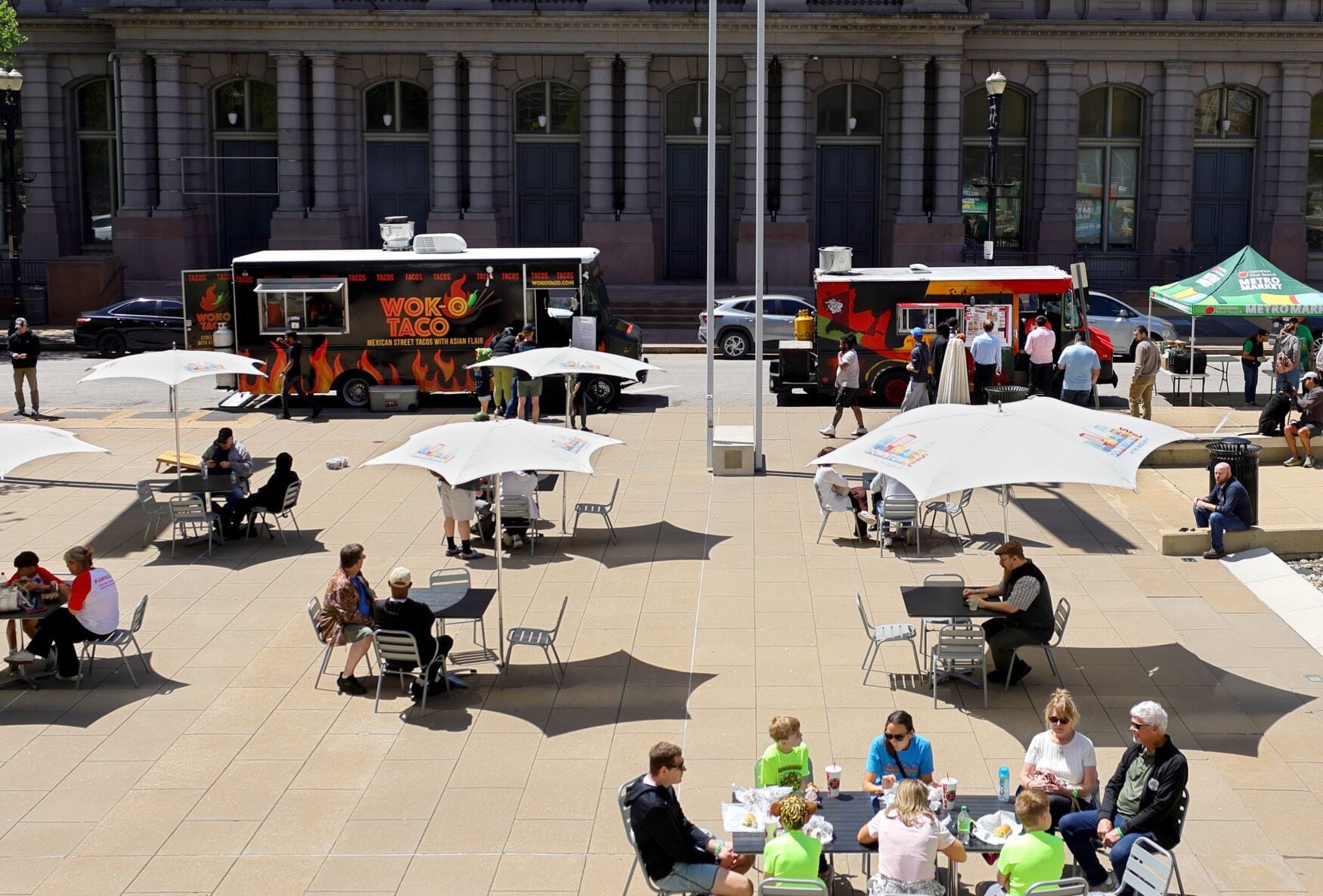
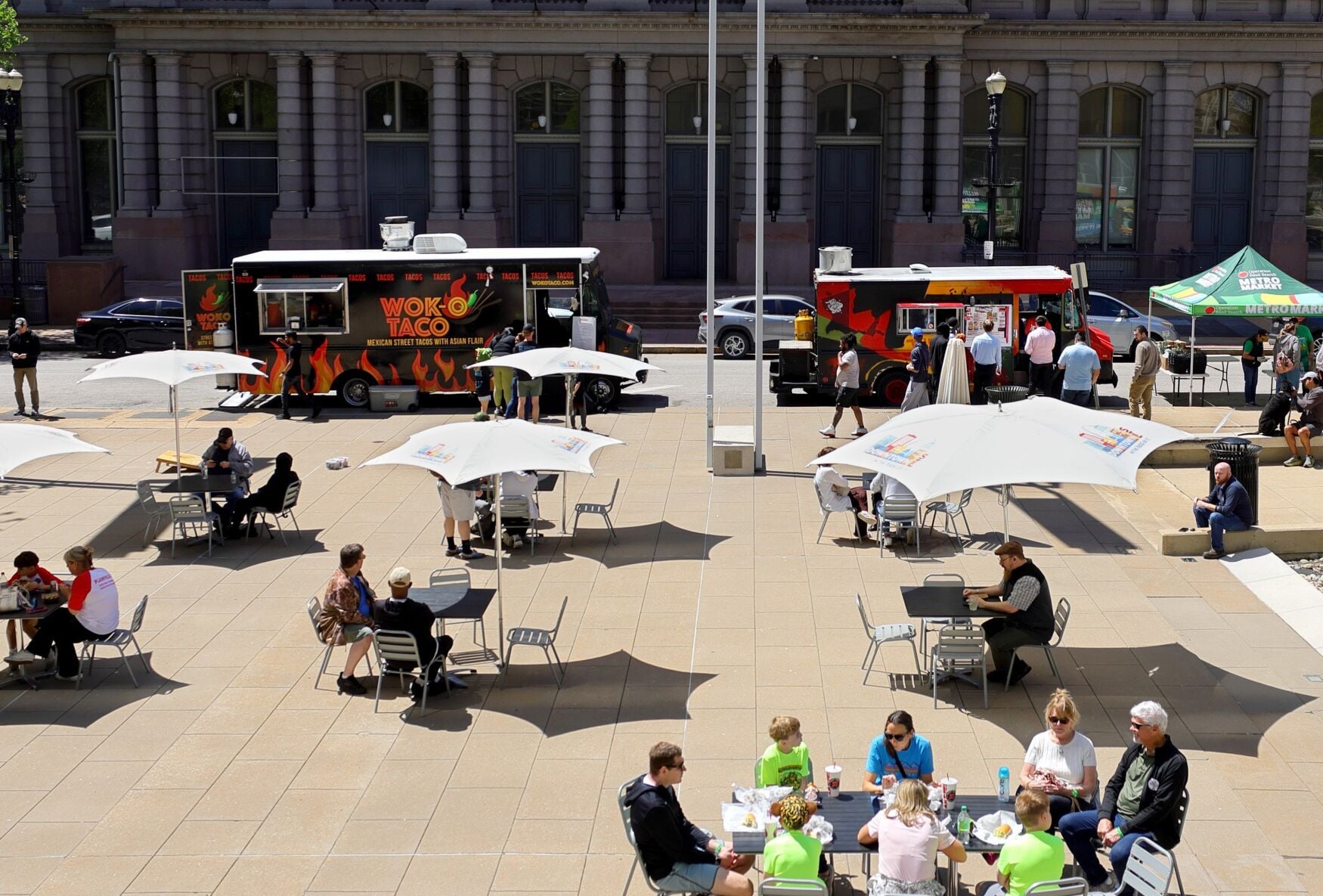
People gather for lunch on Old Post Office Plaza in downtown St. Louis while enjoying lunch from food trucks parked along Olive Street on Wednesday, April 29, 2026.
This series was conceived, and its subjects interviewed, by the Post-Dispatch Editorial Board: Editorial Page Editor Kevin McDermott, Post-Dispatch Publisher Ian Caso, and community board members Antonio French, Janet Y. Jackson and Lynn Schmidt. It was researched and written by McDermott.


Steve Smith, co-founder of Lawrence Group, believes we need to rally together to move the area forward or risk losing younger generations to other cities.