
In downtown St. Louis, as on the rest of planet Earth, COVID changed everything.
Although the city’s central core was already bleeding away the retail and entertainment venues that enlivened the neighborhood, downtown office culture was still a reliable driver of social and economic activity before the pandemic.
On weekdays, workers would come down from their desks in restored century-old buildings to lunch or happy-hour on and around Washington Avenue, before heading home to the suburbs. Having so many people working in the neighborhood, even if they didn't live there, made downtown feel like a less isolated, less alien setting to many of our regional neighbors.
Then the pandemic hit early in 2020, clearing out offices. Downtown employers who had been reluctant to embrace the growing trend of remote work suddenly had no choice. Meanwhile, downtown bars and restaurants suspended business; storefronts were shuttered.
People are also reading…
The businesses that managed to hold on until society re-opened were then hit with a new reality: Many of the workers who had been stationed downtown, and who had been working from their dining room tables throughout 2020, would continue doing so. They — and their happy-hour dollars — weren’t coming back.
The Post-Dispatch Editorial Board this week is publishing a series of editorials exploring how St. Louis can revive its troubled downtown/Downtown West corridor. That’s the more than two-square-mile stretch from the Arch grounds on the east, to Jefferson Avenue on the west, to Chouteau Avenue on the south, to just beyond Washington Avenue on the north. We are keeping all the editorials in the series outside our paywall, free to everyone, to include as many community members in the conversation as possible.
Today, we focus on the decline of office culture — and how it might be turned into a win.
The concept, strongly supported by city officials, downtown business and community boosters, is to transform all that vacant former office space into residential living.
While the neighborhood is home to far more St. Louisans today than it was at the start of the current century, it's still far from the necessary critical mass of residency to support restaurants and other amenities that can no longer count on office workers.
"Ten years ago, Washington Avenue was really vibrant ... before this sort of mass exodus" during and after the pandemic, said Marc Hubbard, general manager at Hair of the Dog, a bar on the strip where he has poured drinks for a decade. "That's when it started getting kind of 'Mad Max' down here."
“There's definitely been a shift, not just here in St. Louis but across the country, across the world,” Sarah Arnosky Ko, vice president of Greater St. Louis Inc., the nonprofit business and civic organization, told the Editorial Board. “A lot of companies don't see the need for those massive floorplans."
The impact of that shift on downtown office space has been profound.

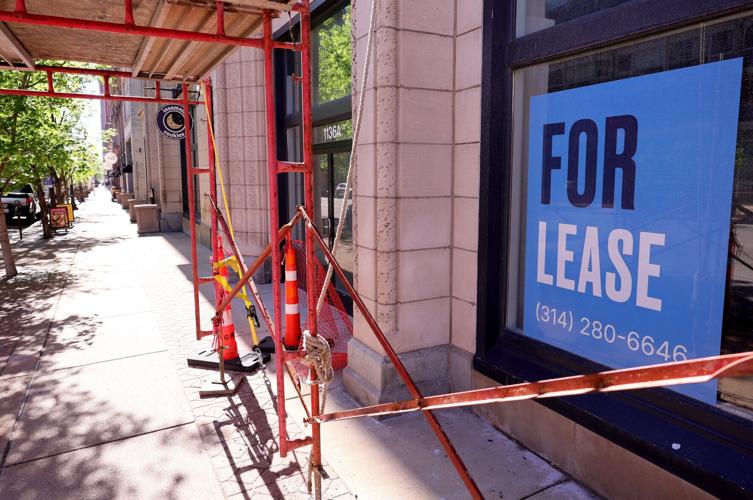
A for lease sign is displayed in a window at Washington Avenue and Tucker Boulevard on Thursday, April 16, 2026.
Gut-punch casualties
A report in January by commercial real estate firm CBRE found that downtown's office vacancy rate for the fourth quarter of 2025 had ballooned to 31.7%, the highest since 1999. That’s compared to a region-wide vacancy rate of 21% — in itself a record high.
And that downtown vacancy rate doesn’t even take into account two of the biggest empty properties: the AT&T Tower and the Railway Exchange Building, which were left off the list because of restoration plans that haven’t yet been realized.
As the Post-Dispatch’s Steph Kukuljan reported, the downtown office drain was highlighted by the exodus of numerous major businesses, including Peabody Energy, FleishmanHillard public relations and KSDK (Channel 5). All had been here for seven decades or more. Other giant tenants, like Blue Cross Blue Shield, have stayed downtown but have downsized their office footprints dramatically.
Bars and restaurants also have left in droves. At a February meeting of downtown residents and businesses, Matt O’Leary, executive director of Downtown Forward, a newly formed nonprofit, rattled off some of the gut-punch casualties: “Wasabi, Flannery's, Lucas Park Grille, Sidebar, Blondies — all gone,” he said. “Pretty much all the commercial tenants on the blocks between Tucker and 14th (along Washington Avenue) are gone.”
Perhaps the unkindest cut of all was from the state of Missouri, which in 2024 vacated the historic Wainwright Building and shipped its state government employees to Chesterfield. Then-Gov. Mike Parson shrugged it off as a standard business decision to consolidate space. Our Editorial Board called it a “middle-finger salute.”
Luckily, others are showing more support for downtown — including the current Missouri Legislature. Not always a friend to St. Louis, the General Assembly this session has been advancing bipartisan legislation to create a $50 million tax credit for conversion of office space to residential units. It could prove crucial to repurposing empty office space.
Under the legislation, developers would be able to claim a tax credit of up to 30% of the cost of converting upper-floor offices to housing. About half the funding would be earmarked for buildings of more than 750,000 square feet — which includes the 44-story AT&T tower, Missouri’s biggest office building, which has sat vacant since 2017. The tower’s current owner, Boston-based Goldman Group, hopes to transform it with a $350 million redevelopment that would include 600 apartments.
It’s one of three behemoth downtown vacancies being eyed for revival with a focus on residential space. The Millennium Hotel complex near the river is undergoing a $670 million mixed-use redevelopment. And the city is trying to acquire the Railway Exchange Building at Sixth and Locust, empty former home to Famous-Barr and Macy’s, with an eye toward getting someone to redevelop it.

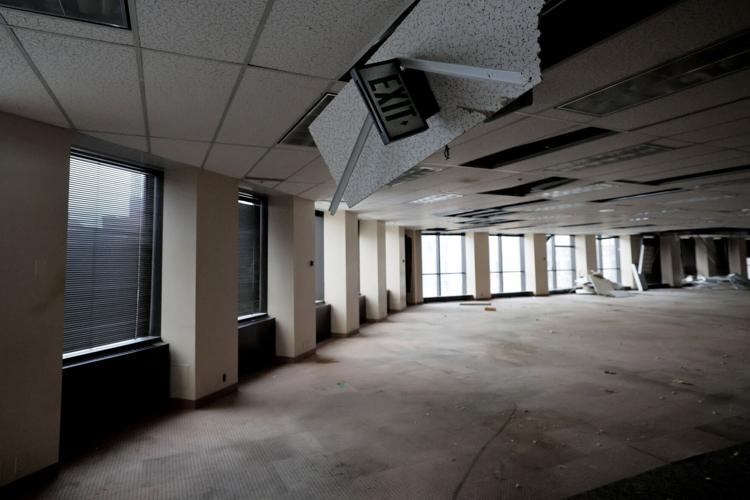
An exit sign dangles from the ceiling on the seventh floor in the former AT&T tower on Feb. 5, 2026, in downtown St. Louis. The 44-story office building containing 1.4 million square feet of office space has sat mostly vacant since the company moved its employees in 2017.
While those and a handful other major properties might present the biggest challenges, reviving downtown will require many smaller projects, too. An empty skyscraper is a problem — but a bigger one is what block after block of empty storefronts and deserted sidewalks looks and feels like to visitors and residents alike.
There are pockets of residential and commercial life throughout the corridor, but they tend to be unconnected islands of activity. Using redevelopment to connect those separate areas is the ideal.
“We have to start on peak corridors like Washington Avenue, or like Seventh Street or Eighth Street,” said Arnosky Ko, of Greater St. Louis. “You're connecting these assets and you're kind of meeting the activity where there are large employment centers or major sports facilities. And you use those as your hubs and then build out from there, and eventually they will connect.”
We certainly have the space for it. There are about 9,000 vacant buildings throughout St. Louis, according to the STL Vacancy Collaborative, a coalition of businesses, residents and others focused on the issue.
While the city as a whole has bled population for decades, the central corridor has done a better job of drawing and retaining residents; it’s home to between 10,000 and 11,000 people today, compared to about 3,000 at the turn of the current century.
But a drive or walk through much of the neighborhood makes clear that’s still too few people for the population density needed to replace the lost activity from the office-worker exodus.

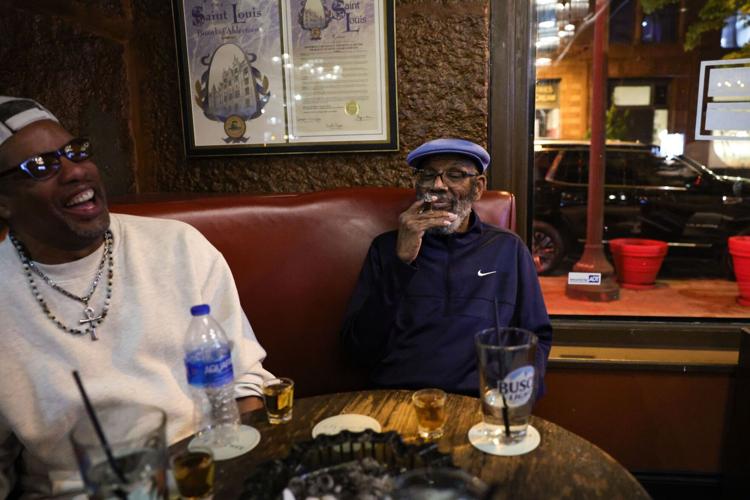
Kenneth Campbell, right, takes a draw on his cigar as he visits with John Shackleford at the Charles P. Stanley Cigar Company in downtown St. Louis, on Monday, April 20, 2026. Both men have lived in downtown St. Louis for decades and have seen it change drastically. “Every city has its ups and downs, but this is a place that a lot of great people live, a lot of genuine people live,” Shackleford said.
Short-lived renaissance
St. Louis should know how to spur a renaissance in residential living. It’s been done before. In the same neighborhood. And not that long ago.
Political consultant Richard Callow arrived here from Washington, D.C., in the early 1990s to work for then-Mayor Vincent Schoemehl.
“I told Mayor Schoemehl that I wanted to live downtown," Callow told us recently. "He said, ‘We’ve got plenty of places.’”
He wasn't kidding. Amid empty buildings along Washington Avenue, Callow recalled, the only full-time residents appeared to be prostitutes, the unhoused and “a robust internet pornography industry” because there was good internet reception.
Callow ended up as the only tenant in a large building on Washington Avenue, paying $500 a month for a 5,000-square-foot unfinished loft.
“During the week, it was people who worked in the loft factories, or the office buildings. There were some clubs that could be noisy at night. There were no residents, so no one complained about the noise," he recalled. "On Sundays, it was tumbleweeds.”
What changed all that — for a while — was a concerted effort to revive the neighborhood, in large part by making it profitable for developers to renovate and sell or occupy those empty historic buildings.
Launched in the late 1990s under Mayor Clarence Harmon, and continued by Mayor Francis Slay in 2001, the public-private initiative was called “Downtown Now!” The idea was to turn what was previously a bustling textile and shoe manufacturing district into a largely residential neighborhood, with an emphasis on dining and entertainment.
With support from Missouri Gov. Mel Carnahan, the initiative offered historic state tax credits that drew in private developers and residents. Beautiful but long-shuttered brick buildings that once served as ornate factories and warehouses were given new life as modern condos and apartments, creating the downtown loft district still in use today. The city did its part with a huge infrastructure initiative to buff up the area’s curb appeal.
“People started wanting to come downtown to live," former Mayor Slay told us in a recent interview. “Some major law firms committed to downtown, which was a big deal. The Schnucks opened up, that was a big deal — we had a grocery store in downtown St. Louis!”
Bolstered by 1,700 new residential units and an influx of new dining, entertainment and office space, the neighborhood’s residential population between 2000 and 2010 more than doubled.
"This downtown corridor — replete with residential and office lofts, boutiques, restaurants, and nightclubs — pulses with activity not seen since its garment district days, a time when sidewalks were filled with window-shoppers and buyers," gushed the American Planning Association in 2011, as it named Washington Avenue one of America’s top 10 "Great Streets.”
A little over a dozen years later, The Wall Street Journal told the nation a much different story.
The neighborhood “stands as a warning to others: This is the future of America’s downtowns if they can’t reinvent themselves and halt the downward spiral,” the newspaper wrote in April 2024 in a piece headlined "The Real Estate Nightmare Unfolding in Downtown St. Louis."
The story used the neighborhood as an example of a post-pandemic “doom loop” of disinvestment. With so many former workers now working from suburban homes instead of commuting into downtown offices, restaurants and other businesses are deprived of a crucial customer base. As restaurants close, the resulting vacant storefronts and empty streets further depress investor interest.

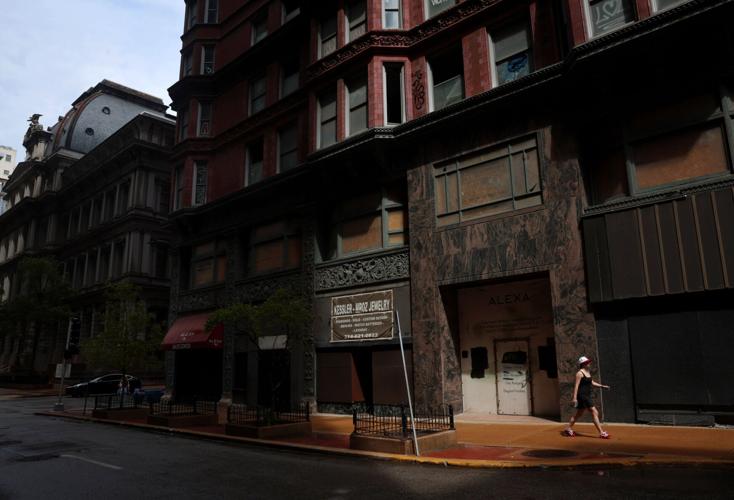
A pedestrian passes the vacant Chemical Building on April 15, 2026. It sits adjacent to the Hotel Saint Louis, which opened in 2018 in a historic building originally designed by Louis Sullivan.
‘Rebirth and reimagining’
If St. Louis has been hit harder by that cycle than a lot of other cities, it’s likely because our downtown had already been sliding from its earlier revival before the pandemic hit. That may have been in part because the city's hyperfocus on downtown through the early 2000s fell away in later years.
At the same time, one of the key drivers of downtown's earlier redevelopment — Missouri’s landmark historic state income tax credit, passed in the late 1990s, to provide 25% credit on qualified rehabilitation — was subsequently revised and restricted by the Legislature.
The historic tax credits in their original form were viewed as a national model because of their generosity (there was initially no cap on the amount rehabbers could claim). They turned one of downtown St. Louis’ biggest liabilities — big, empty, aging brick buildings — into goldmines for the neighborhood, spurring lofts that drew thousands of residents.
But legislative tweaks starting in 2010 put new caps on the incentives, significantly reducing the attraction of the neighborhood to investors.
“The rebirth and reimagining of so many critical buildings in the last 15 years has spurred a pride in the city that had suffered from decades of bad news,” then-St. Louis Alderman Scott Ogilvie wrote in a 2013 essay in the non-profit news platform Next City, decrying the changes to the program. “Missouri’s Historic Tax Credit program has done more than any other incentive to help St. Louis once again put its best foot forward.”
The state now has another chance to help St. Louis' downtown succeed, with the office-to-residency conversion legislation. It's urgent that it's passed into law this session.
Meanwhile, downtown stakeholders — local businesses, investors, civic organizations — should be looking for other ways to incentivize private development that draws in not just sporting and entertainment dollars, but full-time residents.
Downtown loves its visitors. But what the neighborhood needs most of all is more neighbors. We will, in the coming days, delve into some ideas for attracting them.
This series was conceived, and its subjects interviewed, by the Post-Dispatch Editorial Board: Editorial Page Editor Kevin McDermott, Post-Dispatch Publisher Ian Caso, and community board members Antonio French, Janet Y. Jackson and Lynn Schmidt. It was researched and written by McDermott.


View life in St. Louis through the Post-Dispatch photographers' lenses. Edited by Jenna Jones.
Steve Smith, co-founder of Lawrence Group, believes we need to rally together to move the area forward or risk losing younger generations to other cities.